Imagine driving down a highway at sixty miles per hour. If you open your window and try to stick your head out, you will immediately feel the crushing force of the wind. Your eyes water, your cheeks flush, and it becomes almost impossible to take a normal breath. The air pressure is simply too high for your lungs to pull against. Now, imagine multiplying that speed by four. You are moving at 240 miles per hour, plunging straight down toward the earth. For any normal animal, this would be a quick recipe for suffocation and death. But for the peregrine falcon, it is just a regular afternoon hunt.
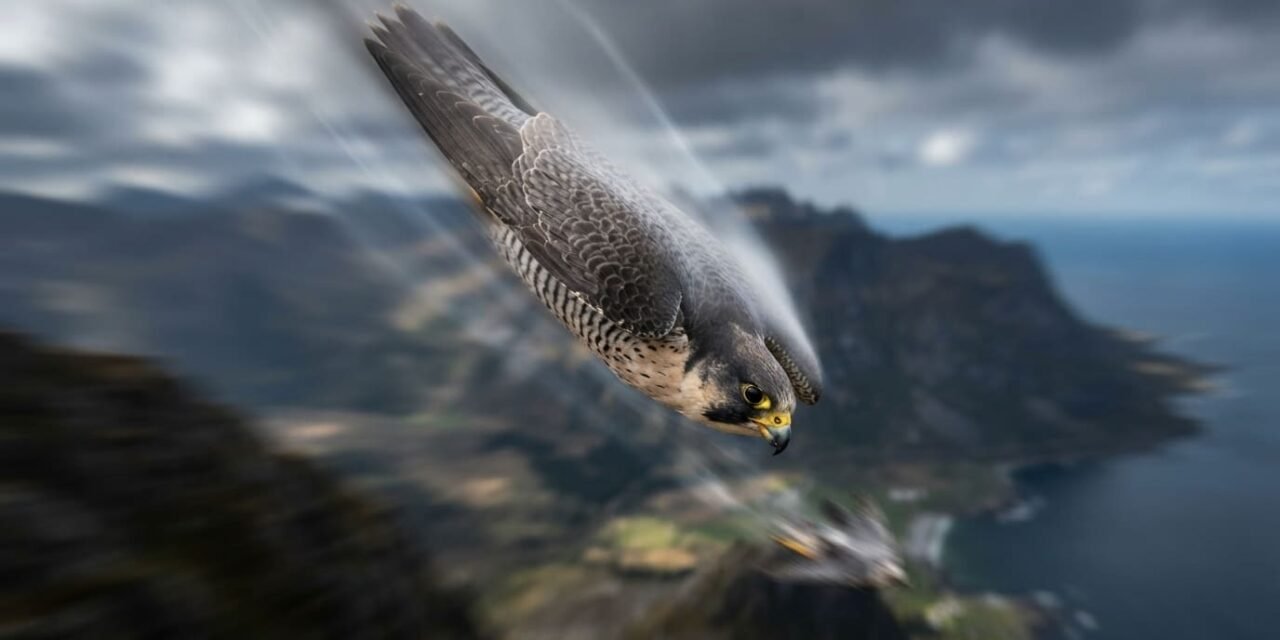
The peregrine falcon (Falco peregrinus) is the fastest animal on the planet. When it spots a target from high in the sky, it folds its wings, tucks its feet, and enters a near-vertical diving run called a stoop. At peak speed, the falcon is a biological missile, cutting through the sky at speeds that match high-performance race cars.
But gravity is only part of the equation. Moving at these speeds presents a massive physical challenge. If a falcon had a normal avian respiratory system, the high-pressure air rushing into its nose during a dive would create a ram-air effect so powerful that its lungs would literally rupture. The bird would choke on the very air it needs to survive. The falcon solved this fluid-dynamics crisis not with stronger lungs, but with a pair of tiny, brilliant structures inside its nostrils.
The Physics of the Ram-Air Barrier
To understand why the falcon’s nose is so important, you have to look at how air behaves at high speeds. When you walk or run, air flows smoothly around your body. It behaves like a gentle, invisible gas. But when you accelerate past one hundred miles per hour, air starts to act more like a fluid, and eventually, like a solid barrier.
As the peregrine falcon plunges toward the earth, the air hitting its face is compressed. This creates a zone of immense high pressure directly in front of the bird’s head. When this high-pressure air enters a standard nasal passage, it wants to expand rapidly.
If this pressurized air reached the falcon’s delicate, thin-walled lungs, it would cause immediate physical trauma. The pressure would force the air sacs to over-inflate and tear. To make matters worse, the speed of the air flowing past the nostrils would create a vacuum effect on the sides of the beak, making it impossible for the bird to actually draw fresh air into its system. Without a way to slow the air down, the falcon would pass out from a lack of oxygen mid-dive, crashing helplessly into the ground.
The Jet Engine Solution: Nasal Tubercles
The falcon’s savior is a tiny, inconspicuous feature inside its nose. If you look closely at the nostril of a peregrine falcon, you will see a small, central peg or cone made of bone and cartilage. This structure is called a nasal tubercle.
For a long time, early naturalists thought these little bumps were just random biological quirks, perhaps meant to keep dirt or dust out of the nose. But they actually serve a critical aerodynamic purpose. They act as inlet baffles, splitting and redirecting the incoming wind.
When the 240-mile-per-hour wind hits the falcon’s nostril, it does not rush straight down the throat. Instead, it collides with the tubercle. The cone shape splits the single, high-pressure stream of air into several smaller streams. It forces the air to travel in a tight, swirling pattern, creating a series of miniature vortexes inside the nasal cavity.
This swirling action has a dramatic effect: it slows the air down. By the time the air passes the tubercle and moves into the respiratory tract, its velocity has been reduced to a gentle, manageable breeze. The falcon can breathe comfortably and deeply, even while moving at terminal velocity.
The Human Jet Connection
This biological design is so efficient that human engineers eventually copied it. During the middle of the twentieth century, aviation engineers began building the first generation of supersonic jet aircraft. As these planes flew faster and faster, the designers ran into a major wall.
When a jet engine moves at high speeds, the air entering the front intake can become turbulent and pressurized. If the air enters the engine’s compressor stages too quickly, it causes a phenomenon called “engine choke” or compressor stall. The engine literally suffocates because the air is moving too fast for the fuel to burn stably.
The engineers needed a way to slow down the incoming air before it reached the engine’s core. They looked at the natural world for answers and found the peregrine falcon.
By studying the shape and function of the falcon’s nasal tubercles, engine designers developed “inlet cones” or diverter spikes. If you look at the intake of modern jet engines or military fighter planes, you will see a prominent metal cone sitting right in the center of the opening. This cone does the same job as the falcon’s nose peg. It splits the incoming supersonic air, creates a controlled shockwave, and slows the air down so the engine can breathe and burn fuel efficiently. It is a direct translation of avian biology into human steel.
An Aerodynamic Body Built for the Drop
The nostrils are only one part of the falcon’s high-speed survival system. The bird’s entire anatomy is modified to handle the physical stress of the stoop.
When the dive begins, the falcon tucks its wings tightly against its body, forming a perfect teardrop shape. This shape is the most aerodynamic structure known to physics, minimizing drag and allowing gravity to do its work without resistance. Even the feathers are specialized. While a normal bird has flexible, soft feathers, the peregrine’s feathers are incredibly stiff and compact. They lock together like the tiles on a spacecraft, preventing the wind from catching an edge and ripping them away.
Keeping the eyes open at 240 miles per hour is another challenge. The wind would dry out the eyes in seconds, and dust particles would cause permanent blinding damage. To solve this, the falcon has a third eyelid called a nictitating membrane.
During a dive, this semi-transparent membrane sweeps continuously across the eye. It acts like a pair of high-speed windshield wipers, spreading thick, viscous tears across the cornea to keep it moist while protecting the eye from debris. The falcon can see its prey with perfect, crystal-clear focus throughout the entire descent.
The Final Fist Strike
The climax of the stoop is a display of pure kinetic energy. At 240 miles per hour, the falcon cannot simply grab its prey with open claws. If it tried to squeeze a flying pigeon at that speed, the impact would break the falcon’s own legs and tear its joints apart.
Instead, the falcon balled up its feet into a pair of tight, heavy fists. As it passes the target bird, it delivers a high-speed strike with its back talons. This impact is incredibly loud, sounding like a small gunshot echoing through the air.
The sheer force of the collision is usually enough to kill the prey instantly, breaking its neck or wings. The target drops through the air like a stone. The falcon then loops back around, catches the falling bird in mid-air, and carries it to a quiet cliffside or branch to eat.
Final Thoughts
The peregrine falcon is a masterclass in natural engineering. It took the invisible, crushing force of the wind and tamed it using a tiny bump of bone inside its nose. It proved that in the hunt for survival, the shape of a nostril can be just as important as the sharpness of a talon.
The next time you see a passenger jet taking off, look at the center of the engine intake. Think of the small brown bird diving through the clouds of New Guinea or the skyscrapers of New York. Remember that the technology carrying humans across oceans was perfected millions of years ago on the wind-swept cliffs of the wild, one fast dive at a time.