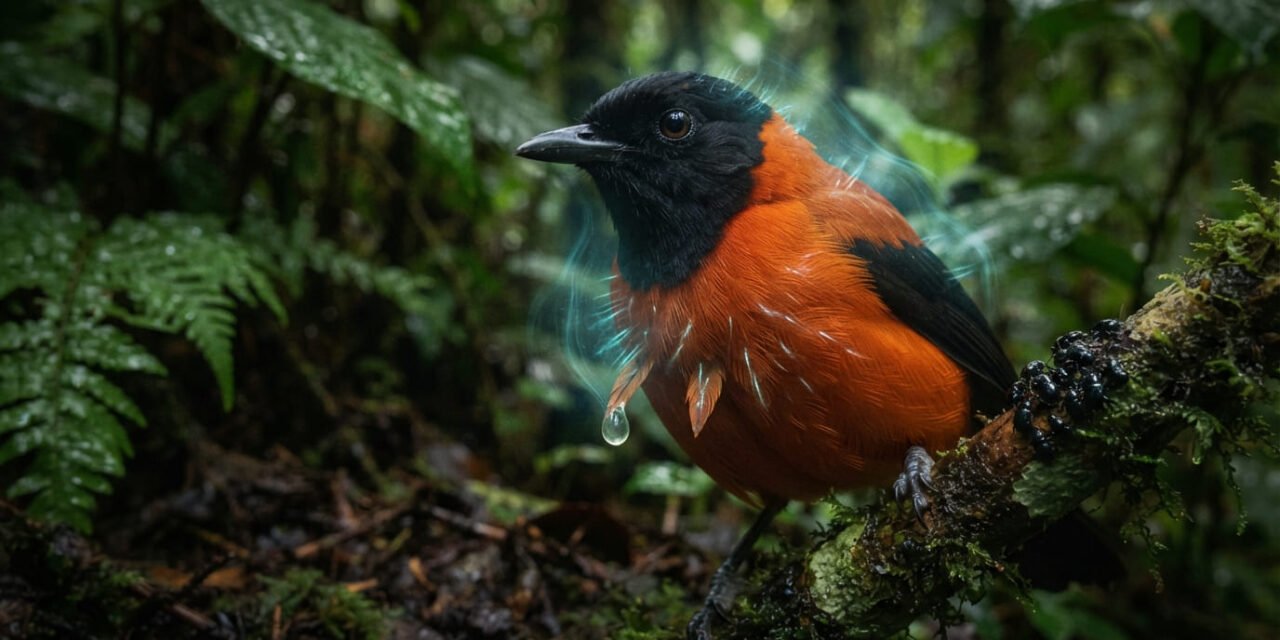
If you were walking through the dense, humid rainforests of New Guinea, you might hear a beautiful, clear whistle echoing through the canopy. The song is complex and musical, sounding like something you would expect from a harmless backyard songbird. If you followed the sound, you would spot a striking bird about the size of a blue jay. It has a jet-black head, wings, and tail, contrasted against a bright, warm brick-orange belly and back. It is a gorgeous animal. But if you were to reach out and grab it, you would make a mistake that could leave your hands numb, your throat burning, and your life in danger.
This is the Hooded Pitohui (Pitohui dichrous). It is the world’s first scientifically documented poisonous bird. While we are used to the idea of poisonous frogs, snakes, or spiders, the idea of a poisonous bird seems like something out of a myth. Yet, this songbird carries one of the most lethal neurotoxins on the planet, concentrated in its skin, its feathers, and its organs.
The Accidental Discovery
For thousands of years, the indigenous people of New Guinea knew all about the pitohui. They called it the “rubbish bird” or the “garbage bird” because it tasted terrible and made people sick. But Western science did not discover the bird’s secret until 1989. It happened entirely by accident.
A young researcher named Jack Dumbacher was working in the rainforests of New Guinea, capturing birds with fine-mesh nets called mist nets. As he was freeing a Hooded Pitohui from the net, the bird scratched his finger. As most people would, Dumbacher instinctively put his cut finger into his mouth to soothe the pain.
Within minutes, his tongue and lips began to tingle. Soon, his entire mouth went numb. The sensation was hot and burning, lasting for several hours. Dumbacher wondered if he had touched a toxic plant, but a few days later, another researcher had the same experience after handling the same bird species. Dumbacher decided to test the feathers. He took a small piece of a pitohui feather and placed it on his tongue. The numbness and burning returned almost instantly. Science had finally caught up with local knowledge: the Hooded Pitohui was chemically armed.
How the Poison Works
When researchers analyzed the skin and feathers of the pitohui, they were shocked by what they found. The bird does not just carry a mild irritant. It carries batrachotoxin. If that name sounds familiar, it is because it is the exact same chemical found in the skin of the Golden Poison Frog of Colombia.
Batrachotoxin is an incredibly powerful neurotoxin. It works by targeting the sodium channels in the nervous system. These channels are like tiny gates that open and close to let electrical signals pass through your nerves and muscles. When batrachotoxin enters the body, it forces these gates to stay open permanently.
Because the gates cannot close, the nervous system cannot transmit signals. The muscles receive a constant, chaotic stream of commands to contract, leading to immediate numbness, tingling, and eventually complete paralysis. If a predator receives a large dose of the toxin, its heart muscles will stop contracting, leading to cardiac arrest and death.
Just a tiny fraction of a gram of this toxin can kill a mouse, and a single pitohui carries enough poison in its skin and feathers to cause severe neurological damage to a human. The numbness Jack Dumbacher felt was the toxin successfully shutting down the nerve pathways in his mouth.
You Are What You Eat: The Beetle Connection
The next big question for scientists was how the bird got its poison. Animals that produce their own toxins usually have specialized glands. The pitohui has no such glands. It does not synthesize the batrachotoxin inside its body. Instead, it gets the poison from its diet.
In the forests of New Guinea, there is a small, unremarkable beetle belonging to the genus Choresine. These beetles are tiny, but they are packed with batrachotoxin. The pitohui eats these beetles by the dozen.
While the beetles are toxic to almost every other animal in the forest, the pitohui is completely immune to the poison. As the bird digests the beetles, its body absorbs the toxin and directs it to the skin and the feathers. The poison acts as an external shield. The highest concentration of the toxin is found in the contour feathers of the breast, belly, and legs. These are the parts of the bird that a predator—or a human—is most likely to touch first.
This is a process called biomagnification. By eating thousands of toxic beetles over its lifetime, the pitohui concentrates the poison in its own tissues, making itself far more dangerous than any single beetle.
The Mystery of Self-Preservation
How does the pitohui eat a poisonous beetle without dying? If a human ate a Choresine beetle, our sodium channels would lock open, and our heart would stop.
The pitohui survived this problem by evolving mutated sodium channels. Under a microscope, you can see that the proteins that make up the sodium channels in a pitohui’s nerves have a slightly different shape than those in other animals. The batrachotoxin molecule is shaped like a key, designed to fit into a specific lock in the sodium channel. Because the pitohui’s “lock” is shaped differently, the chemical key cannot fit. The toxin simply floats past the nerves without doing any damage.
This is a highly specialized evolutionary adaptation. The bird had to change the fundamental chemistry of its nervous system to tolerate its own diet. Because it made this change, it unlocked a food source that no other animal can touch and gained an incredibly effective defense system in the process.
A Warning in Black and Orange
In the wild, there is no point in being toxic if nobody knows about it. If a hawk has to eat you to find out you are poisonous, you still die. To prevent this, toxic animals use bright, contrasting colors to warn predators to stay away. This is called aposematism.
The Hooded Pitohui’s bright orange and black pattern is its warning sign. It is a visual signal that says, “I am dangerous, and I taste terrible.” Local hawks, owls, and tree snakes recognize this pattern and avoid the pitohui.
This warning is so effective that other bird species in New Guinea have started to copy it. The Variable Pitohui (Pitohui kirhocephalus) is another species that carries lower levels of the same toxin. It looks almost identical to the Hooded Pitohui. By sharing the same uniform, both species benefit. Predators only have to learn one warning pattern to avoid both birds. This is a classic example of Müllerian mimicry, where two toxic species evolve to look like each other to reinforce the warning to predators.
The Garbage Bird of New Guinea
While Western science was amazed by the pitohui in 1989, the indigenous people of New Guinea had a very practical relationship with the bird. They knew that the bird was not fit for consumption. They called it “kopone,” which translate roughly to “the bird with bad skin.”
If you were to try and cook a pitohui, the heat would release the toxin into the air, causing your eyes to water and your throat to swell. If you ate the meat, your mouth would go numb, and you would experience severe stomach cramps and vomiting.
However, in times of extreme famine, local people did figure out how to eat the bird safely. They would carefully skin the bird, removing the feathers and the skin where the poison is most concentrated. They would then wash the meat multiple times and cook it over charcoal with specific leaves that were believed to neutralize any remaining toxins. Even then, the bird was a meal of last resort. It was always easier to find something else to eat.
Protection Against More Than Just Predators
The poison shield does more than just protect the pitohui from hawks and snakes. It also protects the bird from a much smaller, more common enemy: parasites.
Bird nests are often filled with mites, lice, and ticks that feed on the birds and their chicks. These parasites can carry diseases and weaken the young birds. The pitohui’s feathers are toxic enough to kill these parasites on contact.
When the parent bird sits on its nest, it rubs its toxic feathers against the eggs and the nest lining. This rubs the poison onto the nesting material, creating a chemical barrier that keeps parasites away. The chicks are born into a sterile, protected environment. This gives them a significant advantage over other songbirds that must constantly fight off infestations.
Final Thoughts
The Hooded Pitohui is a reminder that nature does not follow a set of strict rules. It is a bird that lives like a poison frog, using the chemistry of its diet to build a shield that protects it from the world. It shows us that if the evolutionary pressure is high enough, a species can change its own internal chemistry to turn a toxic beetle into a life-saving tool.
The next time you hear a beautiful song in the woods, remember the pitohui. Remember that the most beautiful singer can be the most dangerous, and that in the rainforest, a splash of orange is often a warning that you should look, but never touch. It is a masterpiece of chemical defense that has been running quietly in the forests of New Guinea for millions of years.