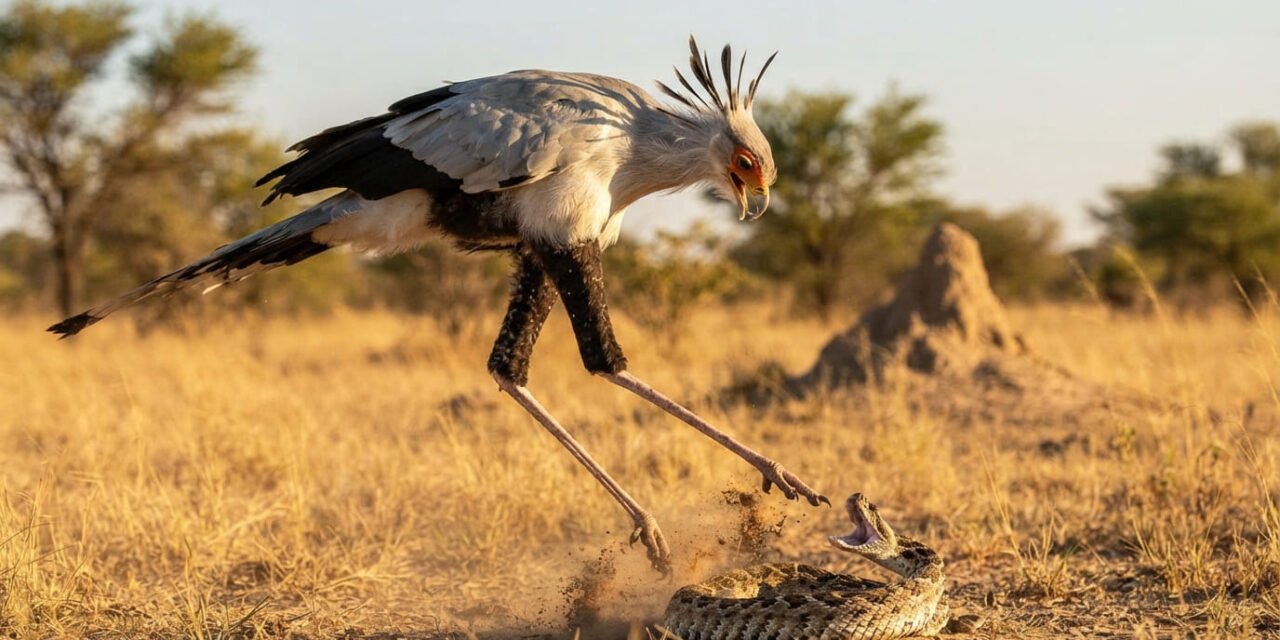
You might think the Secretary Bird looks ridiculous. It has the body of an eagle but the legs of a crane. It stands about four feet tall and walks across the open grasslands of sub Saharan Africa with a stiff, formal gait. Its name likely comes from the black feathers on its head that look like the quill pens nineteenth century clerks tucked behind their ears. But you should not let the appearance fool you. This bird is a highly specialized killing machine. It does not hunt from the air like a hawk. It hunts on the ground. It kills venomous snakes by stomping them to death with a force that defies its own body weight.
The Secretary Bird (Sagittarius serpentarius) is a taxonomic outlier. It is the only member of its family. While other raptors use their talons to grip and pierce prey, this bird uses its legs as hammers. You are looking at a creature that evolved to solve a very specific problem: how to kill a cobra without getting bitten. Its solution is a combination of extreme reach, armored skin, and a kick that happens faster than you can blink.
The Mechanical Design of the Legs
The legs of a Secretary Bird are roughly one meter long. This is nearly half of its total height. These legs are not just for walking. They are the primary weapons of the bird. You will notice that the lower parts of the legs are covered in thick, heavy scales. These scales act as organic armor. When the bird hunts a venomous snake, the snake often tries to strike back. The scales protect the bird from fangs that would easily pierce the skin of a mammal.
The muscles that power the kick are concentrated in the upper leg and the hips. This keeps the lower leg light and aerodynamic. It allows the bird to move its feet with incredible speed. In the world of physics, force equals mass times acceleration. Because the bird can accelerate its foot so quickly, it generates a massive amount of impact force despite the leg being relatively thin.
You should care about this anatomy because it represents a masterpiece of biological engineering. The long legs provide a safety buffer. They keep the bird’s vital organs and its head far away from the ground where a snake might strike. It is a standoff weapon system. The bird stays out of range while delivering lethal damage.
The Physics of the Fifteen-Millisecond Strike
In 2016, researchers conducted a study on a Secretary Bird named Madeleine. They wanted to measure exactly how much force the bird could deliver. They used a force plate hidden under a target. The results were staggering. They found that a Secretary Bird can deliver a kick with a force of about 195 Newtons. This is roughly 20 kilograms of force.
To put this in perspective, the bird only weighs about four kilograms. The kick delivers five times its own body weight in a single blow. This would be like a 180-pound human kicking a door with 900 pounds of force. But the weight is not the most impressive part. The speed is the real story.
The entire strike happens in 15 milliseconds. For comparison, it takes a human about 100 to 150 milliseconds to blink an eye. The bird’s foot travels from a resting position to the target and back again in a fraction of the time it takes you to blink. This speed is necessary because a cobra or an adder has incredibly fast reflexes. If the bird were slow, the snake would move out of the way or bite the foot. The 15-millisecond strike is too fast for the snake’s nervous system to process. By the time the snake realizes it is being attacked, its skull is already crushed.
Tactical Movement and Wing Usage
A Secretary Bird does not just walk up and kick a snake. It uses a series of tactical movements to prepare for the kill. When the bird finds a snake in the tall grass, it begins to circle. It uses its massive wings, which have a wingspan of over two meters, as a distraction. It spreads its wings wide and flaps them to create a chaotic visual field.
The snake becomes confused. It does not know where to strike because the wings are large and provide no vital targets. While the snake is distracted by the wings, the bird positions itself for the perfect shot. It aims specifically for the head of the snake. One or two well placed kicks are usually enough to incapacitate a large cobra.
The wings also serve as a balance bar. When the bird delivers its high speed kick, it often stands on one leg. The force of the strike is so great that it could knock the bird over. The bird flaps its wings to stabilize its body during the impact. This allows it to stay upright and prepare for a second strike immediately if the first one misses.
The Terrestrial Raptor Niche
Most raptors are built for the sky. They have massive breast muscles for flight and short legs to reduce drag. The Secretary Bird went a different way. It spends most of its day walking. It can cover 20 to 30 kilometers in a single day while searching for food. It is more like a dinosaur than a modern bird in how it moves across the landscape.
You will find these birds hunting in areas where the grass has recently burned. The fire drives out small mammals, lizards, and insects. The Secretary Bird walks through the ash and kills anything that moves. While it is famous for killing snakes, it is an opportunistic predator. It eats grasshoppers, mice, and even small tortoises. It kills these smaller animals with the same stomping motion. It is a highly efficient way to hunt because it does not require the bird to bend down and expose its head to danger.
Evolution and Survival
The Secretary Bird is a survivor. It fills a niche that no other bird in Africa occupies. It is a top tier predator that manages the population of venomous reptiles. Without these birds, the balance of the savannah would shift.
You can see the results of its specialized evolution in its survival rate. Very few animals can hunt a Black Mamba or a Puff Adder and win consistently. The Secretary Bird does it every day. It has taken the standard raptor body plan and modified it for ground combat. It traded the ability to snatch prey from the water or the trees for the ability to deliver the fastest kick in the animal kingdom.
The bird is currently listed as endangered. Habitat loss and the use of pesticides in farming are the biggest threats. As the open grasslands are turned into farms, the birds lose the space it needs to perform their long daily hunts. Protecting this bird is not just about saving a strange looking creature. It is about protecting a unique biological weapon system that keeps the savannah healthy.
Observing the Stomp
If you ever get the chance to see a Secretary Bird hunt, you should pay attention to the sound. The impact of the foot hitting a target is audible. It is a sharp, dry crack. This is the sound of bone hitting bone at high velocity. The bird does not use its beak until the prey is dead or completely paralyzed. Once the kicking is over, the bird uses its hooked beak to tear the prey into manageable pieces.
It swallows smaller snakes whole. For larger prey, it uses its feet to hold the body down while it pulls the meat away. Even in death, the snake remains a threat due to residual venom, so the bird is careful to avoid the head area until the meal is finished.
Final Observations
The Secretary Bird proves that you do not need to be the biggest or the heaviest animal to be the most dangerous. You just need to be the fastest. By concentrating its power into a 15 millisecond window, the bird overcomes the defenses of some of the most venomous creatures on earth.
It is a bird that lives by the rules of mechanical efficiency. It uses its height for safety, its scales for armor, and its speed for impact. It is a reminder that nature often finds the most violent and effective solutions to the problem of survival. When you see a Secretary Bird walking across the plains, remember that you are looking at the strongest kick in the savannah. It is a bird that turned a walk in the park into a lethal art form.