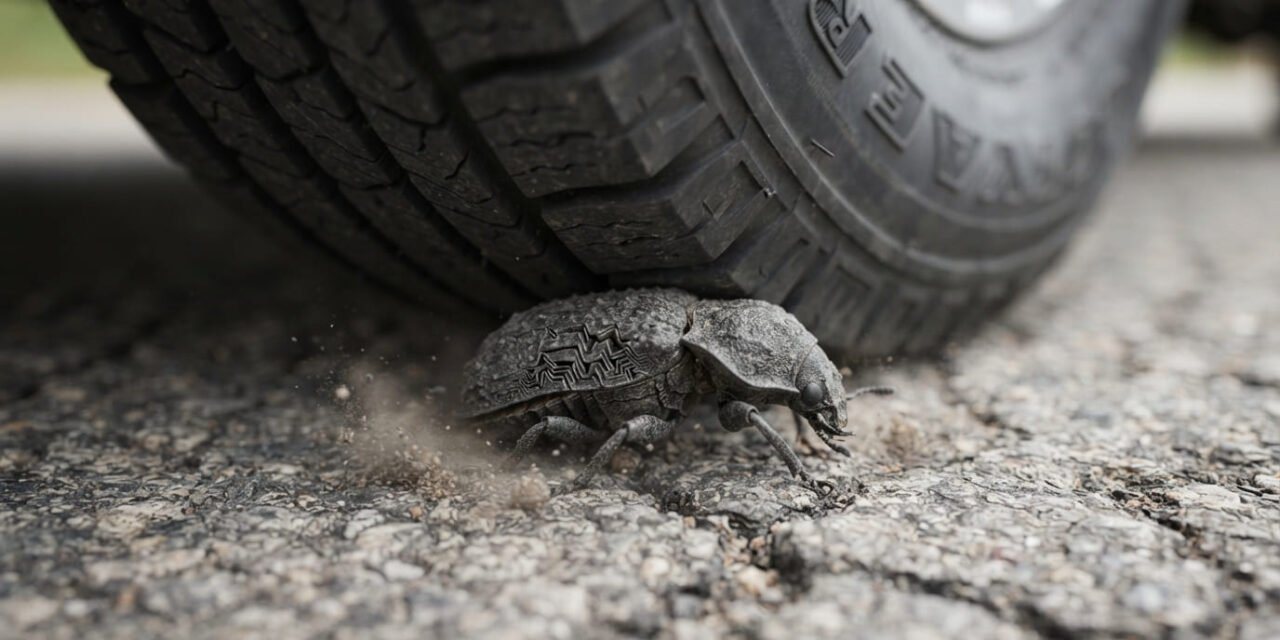
If you find a Diabolical Ironclad Beetle (Phloeodes diabolicus) in the scrublands of Southern California, you might try to squash it. Most people who encounter this beetle eventually realize that their foot is not enough to kill it. If you drive a car over this insect, it will often walk away once the tire passes. This is because the beetle has evolved a shell that can withstand a force of 149 Newtons. That is approximately 39,000 times its own body weight. For a human to match this feat, you would have to survive being crushed by 25 blue whales.
The Diabolical Ironclad Beetle is flightless. Unlike most beetles that have thin, fragile wing covers called elytra, this species has fused its elytra together into a permanent shield. This shield is so hard that entomologists have to use a drill to put a specimen on a display pin. Standard stainless steel pins simply bend when they hit the shell. This durability is the result of millions of years of evolution in an environment full of heavy footed predators and crushing environmental pressures.
The Architecture of the Fused Elytra
The secret to the beetle’s survival lies in the way the two halves of its shell meet. In most beetles, the elytra are separate so they can lift them to fly. Because the Ironclad Beetle gave up flight, it was able to lock these two halves together using a specialized joint called a suture. Under a microscope, this suture looks like a series of interlocking jigsaw puzzle pieces.
These jigsaw lobes are the key to load distribution. When you apply pressure to the top of the beetle, the force does not press straight down onto the internal organs. Instead, the force moves sideways through these interlocking lobes. The lobes are elliptical in shape. This specific geometry is superior to a circular shape because it spreads the stress more evenly across the joint.
When the pressure becomes extreme, the lobes do not snap. They are made of a protein and chitin matrix that is layered like plywood. As the force increases, these layers undergo a process called delamination. The layers slide past each other and slowly pull apart without breaking the entire structure. This allows the shell to deform slightly under a car tire and then spring back into its original shape once the weight is removed.
Mechanical Joints and Force Distribution
Researchers at the University of California, Irvine, and Purdue University tested the limits of this beetle using specialized compression plates. They found that the Diabolical Ironclad Beetle can handle nearly twice the force of its closest relatives. While other beetles in the same family failed at 68 Newtons, this species reached 149 Newtons before the shell finally cracked.
The beetle has two different types of joints along its body. Near the front of the beetle, around the vital organs like the heart and the gut, the joints are stiff and interlocked. They act like a rigid cage that refuses to budge. Near the back of the beetle, the joints are more flexible. They allow the shell to compress. This combination of a rigid front and a flexible rear ensures that the most important parts of the beetle stay protected while the rest of the body absorbs the impact.
The chemical composition of the shell also changes depending on the location. The suture area contains a high concentration of protein that adds toughness. The outer parts of the shell are more mineralized and harder to protect against the initial strike of a predator’s beak or a rodent’s tooth. This gradient of hardness and flexibility is something that human engineers struggle to replicate in a single material.
The Problem with Specimen Pins
In the world of insect collecting, the Ironclad Beetle is a legend. Most insects are pinned using a standard size 2 or size 3 steel pin. You push the pin through the right wing cover and into the corkboard. When you try this with a Diabolical Ironclad Beetle, the pin often curls into a spiral. The shell is effectively a piece of organic armor plating.
To mount these beetles, scientists often have to pre-drill a hole using a jeweler’s drill or a high speed rotary tool. This extreme hardness is a defense against pecking birds. A bird like a woodpecker or a jay can deliver a sharp, concentrated blow. The Ironclad Beetle’s shell is designed to deflect that energy. Because the shell is also rough and bumpy, it is difficult for a predator to get a good grip on the insect. The beetle often plays dead, tucked into a crevice, knowing its armor will likely outlast the patience of the hunter.
Engineering Applications in Aerospace
You should care about this beetle because its shell provides a solution for one of the biggest problems in modern engineering: joining two different materials. In the aerospace industry, engineers often have to join metal parts to carbon fiber parts. They usually use bolts or rivets. These bolts create “stress concentration points” where cracks often start.
By studying the jigsaw sutures of the Ironclad Beetle, engineers are developing new ways to join aircraft components. If we can use the beetle’s interlocking lobe design, we can create joints that distribute weight more naturally. This would eliminate the need for heavy bolts and reduce the weight of airplanes and rockets. It would also make these vehicles safer because the joints would delaminate slowly under stress instead of failing suddenly.
The beetle’s design is already being used to create 3D printed mechanical fasteners. These fasteners are much tougher than standard screws because they use the same “sliding layer” physics found in the beetle’s chitin. This is a direct example of how a small, flightless insect in the California desert is helping humans build better machines.
Survival in the Scrubland
The Diabolical Ironclad Beetle does not move fast. It does not have venom. It cannot fly away from a predator. It survives by being the hardest thing in the forest to eat. It spends its life on the underside of tree bark or under rocks, feeding on fungi. Its life is slow and methodical.
This slow pace is possible because the beetle has very few natural enemies that can bypass its armor. While a larger animal might be able to swallow the beetle whole, the insect is often too hard to digest and can sometimes pass through a predator’s digestive tract intact. Its strategy is the ultimate form of passive defense. It has bet its entire existence on the strength of its jigsaw joints.
Evolution and Flightlessness
The decision to fuse the elytra was a significant evolutionary turning point. Most insects use flight to find food, find mates, and escape danger. The Ironclad Beetle traded that mobility for a 149 Newton armor rating. This transition happened over millions of years as the beetle moved into niches where heavy armor was more valuable than the ability to fly.
By fusing the wing covers, the beetle also created a more airtight seal. This helps it retain moisture in the dry, hot climate of the American Southwest. The shell acts as a canteen, keeping the internal environment humid even when the outside air is scorching. This dual purpose—protection from crushing and protection from drying out—makes the beetle a master of its specific environment.
Final Thoughts
The Diabolical Ironclad Beetle is a biological tank. It uses geometry and material science to solve the problem of survival. The elliptical lobes, the layered chitin, and the varying stiffness of its joints all work together to create a shell that defies the laws of scale. It is an insect that can withstand the weight of a human vehicle and keep walking.
We are only beginning to understand the full complexity of this beetle’s armor. As we look closer at the microscopic sutures, we find more details about how the protein fibers are woven together to prevent cracks. The Ironclad Beetle is a reminder that the most effective engineering solutions often exist right under our feet. It is a tiny, six legged lesson in how to build things that do not break.