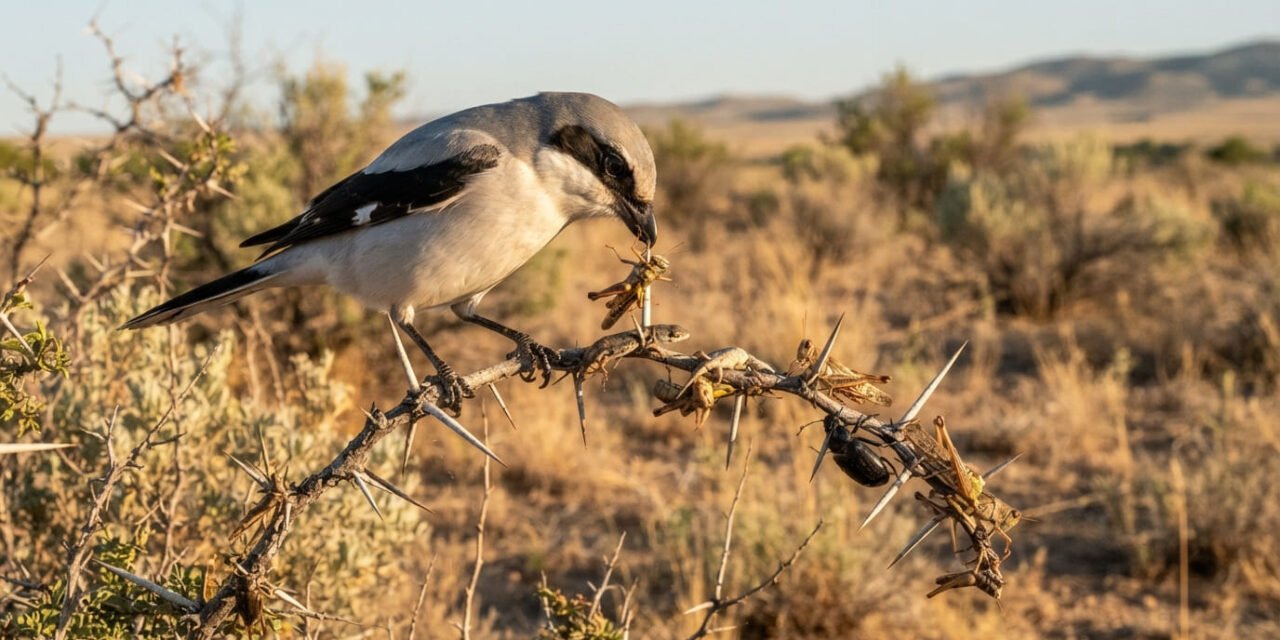
If you take a slow drive down a rural, sun-baked country road anywhere from the open prairies of the American Midwest to the scrublands of Florida, you might spot a small, unassuming bird perched on a barbed-wire fence. It is about the size of a robin, mostly gray and white, with a striking black mask across its eyes. It looks like a classic songbird, perhaps a mockingbird wearing a bandit mask. It sits perfectly still, observing the pasture.
But if you stop your car and walk up to that fence, you might see something that shatters that innocent image entirely.
Strung along the rusty barbs of the fence, you might find a heavy grasshopper, a large beetle, a small lizard, or even a field mouse. These animals are not just resting. They are dead, and they have been violently impaled on the sharp metal spikes, left hanging in the sun like cuts of meat in a butcher’s window.
You have just stumbled into the outdoor pantry of Lanius ludovicianus, commonly known as the loggerhead shrike.
Because of this deeply unsettling habit of staking its victims onto thorns and fences, it has earned a much more accurate, albeit terrifying, nickname: the butcherbird. To understand why a bird that looks like it should be eating seeds at a backyard feeder is actually behaving like a ruthless apex predator, you have to look at an incredible evolutionary workaround. The loggerhead shrike is a bird that possesses the ambition and appetite of a hawk, but completely lacks the physical equipment to pull it off. So, it invented a tool.
The Songbird with a Raptor’s Appetite
To really appreciate the hunting tactics of the loggerhead shrike, you have to understand its physical limitations.
True birds of prey, like a red-tailed hawk or a peregrine falcon, are built for murder from the ground up. They have massive, heavily muscled legs and long, curved talons. When a hawk catches a mouse, it uses those powerful feet to puncture the animal’s vital organs, killing it almost instantly. Then, the hawk stands on top of the heavy carcass, using its own body weight and talons to pin the meat to the dirt while it uses its beak to tear off bite-sized pieces.
The loggerhead shrike does not have talons. It belongs to the order Passeriformes, which makes it a perching bird, or a songbird. Its feet are small, delicate, and entirely designed for gripping thin branches. If a shrike tries to stand on a dead mouse and pull a piece of meat off, its feet are too weak to hold the carcass down. The bird would just end up dragging the mouse across the grass.
Despite this dainty anatomy, Lanius ludovicianus is a fierce carnivore. It aggressively hunts large insects, small amphibians, reptiles, and even other small birds. It frequently targets rodents that are incredibly large compared to its own body size, such as the deer mouse (Peromyscus maniculatus).
So, how does a songbird kill and eat an animal that it physically cannot hold down?
The killing part is solved by a highly specialized beak. While the shrike lacks talons, it does possess a heavy, sharply hooked upper beak. More importantly, just behind the tip of that hook, it has a tiny, sharp notch called a tomial tooth. This is the exact same anatomical feature found on the beaks of falcons.
When the shrike spots a mouse moving in the grass, it drops from its perch and strikes. It grabs the rodent by the back of the neck and bites down hard. The tomial tooth acts like a wedge, slipping perfectly between the vertebrae of the mouse’s neck, severing the spinal cord and paralyzing or killing the prey instantly. If the animal is particularly large and struggling, the bird will aggressively shake its head side to side, using the whiplash force to break the neck.
The Invention of the Meat Hook
Killing the prey is only the first half of the battle. The shrike now has a dead mouse in its beak, but it still can’t tear it apart to eat it.
This is where the impaling comes in. The shrike flies the carcass to a carefully selected location. Historically, this meant finding a heavily thorned bush or tree, such as a hawthorn (Crataegus) or a honey locust. In modern, human-altered landscapes, the bird has enthusiastically adapted to using barbed-wire fences.
The bird uses its beak to physically jam the dead animal onto a sharp thorn or a metal barb. It pushes with surprising force, ensuring the spike goes deep into the tissue so the carcass is securely anchored.
Once the animal is impaled, the thorn acts exactly like a meat hook in an abattoir. It takes the place of the talons the bird doesn’t have. With the mouse firmly stuck in place, the shrike can now plant its delicate feet on the branch, grab a piece of meat with its hooked beak, and pull backward with all its strength, easily tearing the carcass into manageable, bite-sized strips.
It is a stunning example of behavioral adaptation. The shrike essentially uses its environment as an external tool, outsourcing the heavy lifting of holding its prey to the thorny bushes of the prairie.
Building the Larder
While impaling prey solves the immediate problem of how to eat, Lanius ludovicianus takes the behavior a step further. They don’t just impale animals when they are hungry. They impale animals constantly, building up massive, grotesque collections of dead prey called larders.
A well-stocked larder might feature dozens of insects, a few dried-out frogs, and several mice, all strung up along a single stretch of fence or concentrated in one dense thorn bush.
These larders serve as a critical survival mechanism during times of scarcity. In the early spring, when unpredictable cold snaps can suddenly kill off insect populations and force rodents underground, a shrike might find itself entirely without fresh food for days at a time. When hunting gets tough, the bird simply returns to its larder. Even if a mouse has been baking in the sun for several days and is completely dried out into jerky, the bird can still tear it apart and eat it, guaranteeing a steady source of calories when other birds are starving.
Chemical Warfare and the Toxic Grasshopper
Perhaps the most brilliant use of the larder involves an exercise in chemical detoxification.
In the southern parts of the loggerhead shrike’s range, such as Florida and the Gulf Coast, the fields are full of the eastern lubber grasshopper, scientifically known as Romalea microptera. These grasshoppers are massive, slow-moving, and look like a remarkably easy meal.
But most predators avoid them completely. The lubber grasshopper is highly toxic. It secretes a foul-smelling, poisonous foam from its thorax when attacked, which can cause severe vomiting and sickness in birds and mammals.
Lanius ludovicianus has figured out a way around this chemical defense. The shrike will catch the toxic grasshopper, kill it, and impale it on a thorn. But instead of eating it right away, the bird simply leaves it there.
The shrike instinctively knows that the grasshopper’s toxic compounds degrade over time when exposed to the sun and the air. The bird will wait exactly one or two days. After the waiting period is over, the toxins have broken down completely, and the shrike returns to safely eat a massive, protein-rich insect that no other predator in the ecosystem is capable of touching. It is a level of calculated patience and dietary chemistry that is incredibly rare in the avian world.
A Macabre Courtship Display
Beyond food storage and detoxification, the larder serves one final, crucial purpose for the loggerhead shrike: it is an advertisement for mating.
When the breeding season approaches in the spring, male shrikes work overtime to build the largest, most impressive larders they possibly can. They will often place their kills in highly visible locations, making sure they are easily seen from a distance. To a female shrike evaluating potential mates, a male with a barbed-wire fence full of dead lizards and mice is incredibly attractive.
The logic is brutally simple. A massive larder proves that the male is a highly capable hunter. It proves that he has secured a territory rich in resources, and most importantly, it guarantees that he will be able to provide plenty of food for her and her chicks when they are confined to the nest. The male is essentially showing off his wealth, using a gruesome jewelry box of rotting prey to win the affection of a mate.
A Fading Predator of the Prairies
Despite their incredible adaptability and ingenious survival tactics, loggerhead shrikes are currently facing a steep decline across much of North America.
Because they rely on open grasslands, pastures, and agricultural edges, they are highly vulnerable to habitat loss. As family farms are replaced by massive, monoculture industrial agriculture, the brushy fencerows, thorn bushes, and untamed edges that the shrikes need to build their larders are being bulldozed away. Furthermore, because they sit at the top of the food chain for small insects and rodents, they are highly susceptible to the widespread use of chemical pesticides, which completely wipe out their food supply and can build up toxically in their own bodies.
When you look at Lanius ludovicianus, it forces you to rethink how you view the natural world. We tend to put animals into neat, easy categories. Songbirds are supposed to sing, eat berries, and be gentle. Raptors are supposed to be the fierce, bloodthirsty killers.
The loggerhead shrike proves that evolution does not care about our categories. It is a creature that was given the body of a mockingbird but possessed the aggressive spirit of a falcon. It looked at its own weak, delicate feet, realized it couldn’t hold down a struggling mouse, and simply decided to turn the entire landscape into a weapon instead. It is a brilliant, highly adaptable, and deeply brutal little bird.