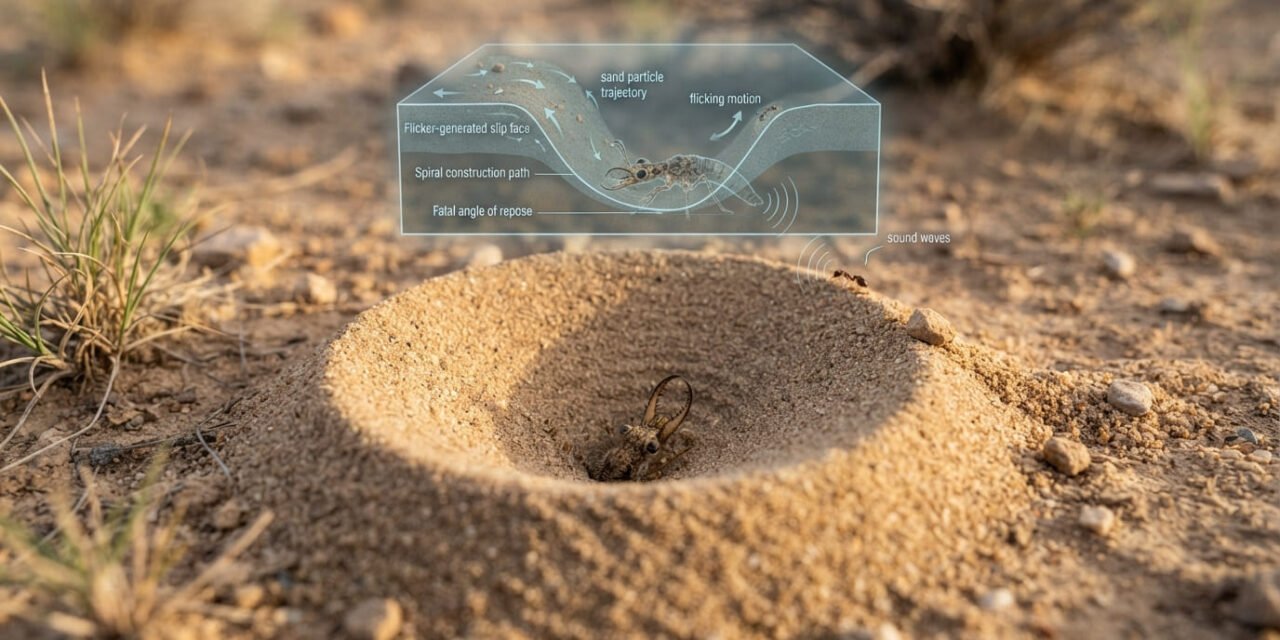
If you walk along a dry, sandy path beneath a porch or a cliffside, you might spot a cluster of small, perfect craters in the dust. They look like miniature volcanic craters, each about two inches wide and an inch deep. To a human, they look like harmless little cups in the dirt. But to a passing ant, these structures are the edge of a slippery slide with no way out. At the bottom of each funnel, buried under a thin layer of dust, sits a predator with massive, curved jaws and a clever plan to let gravity do all its hunting.
This is the antlion larva, often known in North America as the doodlebug. The nickname comes from the winding, messy trails the insect leaves in the sand as it searches for the perfect place to build its home, looking as though someone has been absentmindedly doodling in the dirt with a toothpick.
The antlion larva is a slow, soft-bodied creature that cannot chase down prey. Yet, it manages to capture some of the fastest, most aggressive insects on the forest floor. It does this by turning simple, dry sand into a highly sensitive detector and a deadly trap. By building a simple cone-shaped pit at the absolute limit of stability, the antlion makes a home where any step could trigger a landslide.
The Slipperiest Hill in the Garden
To understand how the antlion’s trap works, you just need to think about how dry sand behaves. Sand is a strange material. When it is packed flat, it acts like a solid. You can walk on it, and it easily supports your weight. But when you pile it up into a hill, its behavior changes.
You can test this yourself with a pile of dry sugar or salt. If you pour it slowly onto a table, it will form a cone. At first, the pile gets taller and steeper. But eventually, it reaches a limit. If you try to add more sugar to make the hill any steeper, the grains will slide down the sides. The pile has a natural tipping point. It is the steepest slope the material can manage before it collapses.
The antlion larva builds its pit so that the walls sit exactly at this tipping point. Gravity pulling the sand down is perfectly balanced by the friction of the grains rubbing against one another. The slope is on the absolute edge of falling apart. Even the slightest touch will ruin this delicate balance.
When an ant walks over the rim of the crater, its feet move just a few tiny grains of sand. This tiny disturbance triggers a chain reaction. The friction holding the sand in place fails, and a mini-landslide begins. The ant loses its footing on the sliding slope and tumbles directly toward the center of the pit, where the antlion’s jaws are waiting.
The Art of the Spiral Dig
Building a perfect cone at this exact tipping point is a difficult task. If the antlion simply dug a hole from the center outward, the walls would constantly collapse on top of it. It would waste all its energy shoveling the same sand over and over. Instead, the larva uses a highly efficient, circular digging technique: the spiral.
The antlion always digs backward. It uses its heavy, wedge-shaped rear end like a plow, pushing its body beneath the surface and moving in a wide circle to mark the outer edge of its future pit. Once the circle is defined, the larva begins to travel in a tightening spiral toward the center.
As it crawls backward along this spiral path, it uses its front legs to load loose sand onto its flat head. With a sudden, powerful flip of its neck muscles, the larva throws the sand up and out of the pit.
This spiral pattern is a masterpiece of efficiency. By digging from the outside inward, the antlion ensures that the sand it loosens is thrown completely away from the working area. If it dug from the inside out, the thrown sand would continuously fall back into the hole, requiring the larva to dig the same spot multiple times. This smart method minimizes construction time, allowing the antlion to build a fully functional trap in about fifteen minutes while saving its precious energy.
Natural Sorting: Rocks and Sand
Nature is rarely clean. A natural patch of soil is not made of perfect sand; it contains a mix of large, heavy pebbles and tiny, fine grains. If the walls of the pit were lined with large pebbles, the trap would fail. Heavy pebbles do not slide easily, and they can provide a climbing ant with a stable foothold to scramble out of the pit.
To solve this, the antlion uses its digging process to sort the materials. When the lava plows through the dirt, the movement naturally separates the grains by size. The larger, heavier pebbles tend to sink to the bottom of the trench it is digging.
Because the larger pebbles are heavier, they are much easier for the antlion to throw far away. Think of it like throwing a ball versus throwing a crumpled piece of paper. The heavier pebble has more momentum, so when the antlion flips its head, the pebbles fly completely clear of the pit, landing far outside the rim.
The smaller, lighter sand grains do not travel as far through the air. They fall short and land back on the inner slopes of the funnel. This natural sorting process ensures that the walls of the finished pit are lined only with fine, slippery sand grains. This makes the slope incredibly unstable and guarantees a major slide the moment prey steps over the edge.
Sensing Footsteps in the Dark
Once the pit is complete, the antlion buries itself at the very bottom, leaving only its long, curved jaws exposed to the air. Because it is completely hidden under the sand, it cannot use sight to see approaching prey. Instead, it relies on a super-sensitive system to feel vibrations.
The body of the antlion larva is covered in specialized, stiff hairs. These hairs are mostly located on the sides of its body. When an insect walks near the edge of the pit, its footsteps send tiny vibrations traveling through the loose sand.
These vibrations travel through the sand grains and wiggle the sensory hairs on the antlion’s body. By measuring the tiny differences in when the vibrations hit different parts of its body, the antlion can calculate the exact direction and speed of the approaching prey. It can tell the difference between a falling leaf, a gust of wind, and the frantic footsteps of a delicious ant.
Active Warfare in the Pit
If a trapped insect is large and strong, it might not slide all the way to the bottom on the first landslide. A beetle or a large ant might manage to stabilize its body on the slope and begin climbing upward to escape the trap.
The antlion does not just sit and watch its dinner escape. It immediately starts an active defense of its home.
Using its head like a high-speed shovel, the larva begins rapidly throwing streams of sand high into the air, aiming directly at the struggling prey. These flying sand grains serve two purposes. First, they strike the body of the escaping insect, throwing it off balance and knocking it back down the slope.
Second, the impact of the thrown sand ruins the fragile balance of the walls above the prey. By pelting the slope, the antlion triggers additional, larger avalanches. The sand beneath the prey’s feet slips away again, dragging the victim deeper into the center of the pit. It is an active, fast-paced defense of the trap’s shape, ensuring that gravity always wins.
Life Without Waste
When the prey finally reaches the bottom of the funnel, the antlion strikes. Its massive jaws are hollow, acting like tiny needles. It drives these jaws deep into the victim’s body, injecting a fluid that paralyzes the prey and dissolves its internal tissues into a liquid.
The antlion then sucks up this rich liquid, leaving behind a dry, empty shell. To keep the pit working well, the antlion must get rid of this garbage. If the pit were filled with empty insect bodies, the slope would become stable, and future prey could use the shells as bridges to climb out. Once the meal is finished, the antlion places the empty shell on its head and flips it high into the air, throwing the waste far outside the crater.
Living buried in the sand presents another major challenge: hygiene. If the antlion left solid or liquid waste while buried, it would ruin its own home. The moisture would glue the loose sand grains together, turning the slippery slope into a solid, stable surface that prey could easily walk on.
To prevent this, the antlion larva has a digestive system with no exit. Throughout its entire larval stage, which can last for up to three years, it never produces solid waste.
Instead, all waste material is stored safely inside a special chamber in its body. It is only when the larva spins its silk cocoon and transforms into a winged adult that it finally releases this stored waste. This clean lifestyle ensures that the sand surrounding the lava remains perfectly dry, loose, and ready to slide.
Final Thoughts
The antlion larva is a reminder that you do not need a massive body or high speed to be a successful predator. Operating with a brain smaller than a pinhead, this tiny insect manages to build a highly effective trap in the dirt. It turns the simple properties of dry sand into a sensitive radar system and an inescapable prison.
When you see a small crater in the dirt on your next walk, take a moment to look closely. You are looking at a structure built on the absolute edge of balance, designed by a tiny builder that has spent millions of years proving that sometimes, the easiest way to catch a meal is to let the sand do the heavy lifting.