If you spent any time in the Namib or Kalahari deserts, you would realize quickly that water isn’t just a resource; it’s the only currency that matters. Most animals stay within a few miles of a water hole because the cost of travel is too high. If you move too far, you burn more hydration than you can replenish.
The Sandgrouse didn’t get that memo.
This bird lives in places where the heat hits 40 °C by mid-morning. It nests in the open sand, miles away from the nearest pool of water, to keep its chicks safe from the predators that hang around oases. But chicks can’t fly for weeks. They need water brought to them.
The male Sandgrouse handles this by turning his own body into a flying canteen. He flies up to 50 miles one way, soaks himself, and flies back. It’s a survival strategy that relies on a specific piece of biological engineering: belly feathers that act like a high-tech sponge.
The Architecture of a Feather
When you look at a typical duck or seagull, their feathers are hydrophobic. Water beads up and rolls off because they need to stay dry to remain buoyant and warm. The Sandgrouse has the opposite requirement.
The feathers on a male Sandgrouse’s belly have a unique microscopic structure. Under a lens, you can see tiny filaments called barbules. In most birds, these stay zipped together. In the Sandgrouse, the base of these barbules is coiled like a spring.
When the bird lands at a water hole, he doesn’t just take a drink. He wades in and performs a rocking motion, deliberately submerging his chest and belly. As the feathers get wet, those coiled barbules unwind. They create a dense, forest-like network of hooks that trap water molecules through capillary action.
Think of it like a microfiber towel. The more surface area those tiny fibers create, the more liquid they can hold. A single male can soak up about 25 milliliters of water. That doesn’t sound like much until you realize the bird only weighs about 300 grams. It’s a massive payload for a long-distance flight.
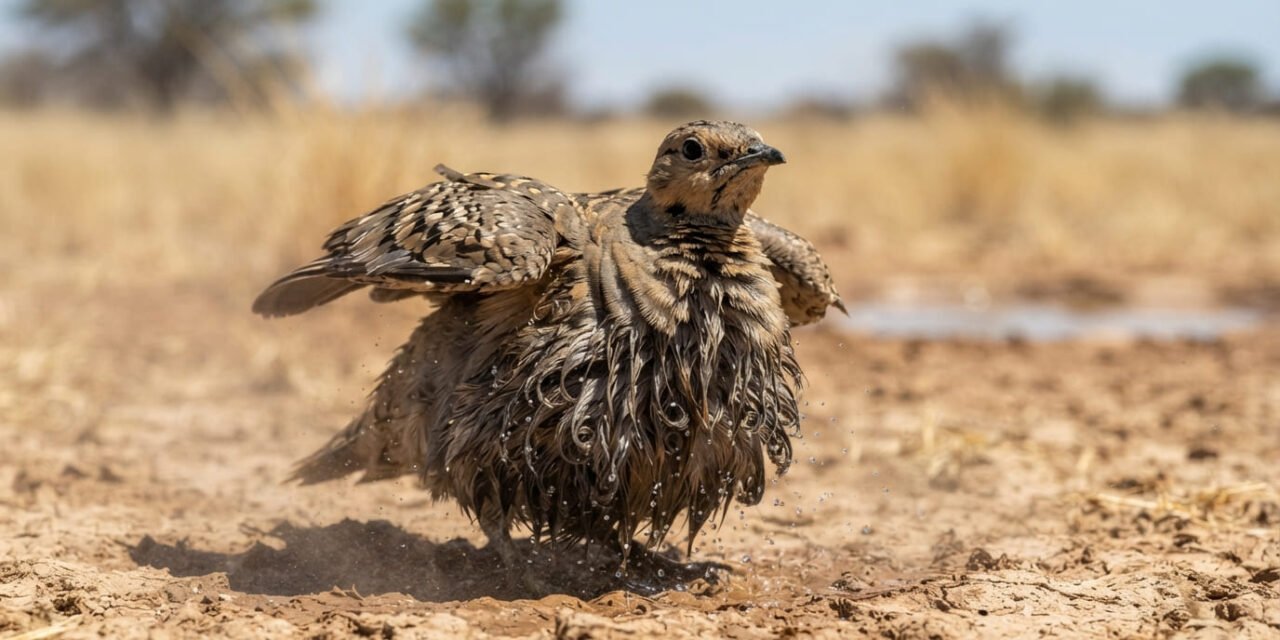
The physical transformation is striking. A dry Sandgrouse looks like any other dusty, camouflaged ground bird. A wet one looks heavy, its belly drooping with the weight of the liquid. The feathers don’t just get damp; they become saturated, holding the water in a structural grip that defies gravity and the vibration of flight.
The 50-Mile Sprint
The flight back is the hardest part. The Sandgrouse is a strong flyer, hitting speeds of 40 to 60 miles per hour. This speed is necessary because evaporation is a constant threat.
As the bird cuts through the desert air, the wind strips moisture away. On a 50-mile return trip, the bird can lose nearly 40% to 50% of the water it started with. He has to carry a surplus just to ensure the “delivery” is enough for the brood.
He also has to worry about his own temperature. Carrying wet feathers helps keep his core cool during the flight, but it also adds weight and drag. It’s a calculated trade-off. He spends more energy flying a heavy, sodden load so his offspring don’t die of dehydration in the mid-day sun.
This journey isn’t a one-off event. It is a daily grind. During the nesting season, the male makes this trip every single morning. He leaves at dawn, navigates the featureless terrain with pinpoint accuracy, and returns before the heat becomes unsurvivable. If he fails once, the chicks likely won’t make it to the next sunrise.
The Delivery
When the male lands at the nest, he doesn’t regurgitate the water like many other birds. Instead, he stands upright and ruffles his belly feathers. The chicks have learned to wait for this. They gather around his legs and use their beaks to “milk” the feathers, drinking the water directly from his plumage.
It’s a strange sight, a group of tiny, camouflaged fluff-balls huddled under their father’s chest in the middle of a barren salt pan. But it works. This ritual happens every single day until the chicks are strong enough to join the morning flight to the water hole themselves.
Observers have noted the patience of the male during this process. He stands still, sometimes for ten or fifteen minutes, as the chicks systematically drain his feathers. He is vulnerable during this time, unable to easily take flight if a raptor appears, yet he remains anchored until the last drop is gone.
The Evolution of Paternal Care
In the bird world, the labor of raising young is often divided, but the Sandgrouse represents a peak of specialized paternal care. While the female often handles the incubation of the eggs during the day, relying on her own camouflage to disappear into the gravel, the male takes on the high-risk logistics of water transport.
This division of labor is a response to the “oas trap.” Predators like jackals, hawks, and snakes know that every living thing in the desert eventually has to visit the water. By nesting 50 miles away, the Sandgrouse effectively removes its most vulnerable family members from the danger zone. The male accepts the risk of the daily commute, so the chicks don’t have to live in a high-traffic hunting ground.
Why This Matters for Us
Engineers look at the Sandgrouse when they want to design better fluid-transport systems. Most human-made sponges are great at holding water but terrible at releasing it predictably, or they’re good at absorbing but can’t hold on during high-speed movement.
The Sandgrouse feather is a lesson in “structural absorption.” It’s not a chemical reaction that holds the water; it’s the physical shape of the material. If we can replicate those uncoiling barbules in synthetic materials, we could create better cooling vests for athletes or more efficient ways to collect atmospheric moisture in arid regions.
Current research into biomimicry is focusing on how these feathers maintain their integrity over thousands of soak-and-dry cycles. Unlike a kitchen sponge that eventually breaks down or loses its springiness, the Sandgrouse’s feathers remain functional for the life of the bird. Understanding the keratin proteins and the geometric arrangement of the barbules could lead to “smart” fabrics that change their porosity based on moisture levels.
Survival is About Specificity
The Sandgrouse is a reminder that nature rarely uses “general” solutions for extreme problems. You don’t survive the desert by being a slightly better version of a forest bird. You survive by evolving a specific, physical tool that bypasses the environment’s limitations.
While other birds are tethered to the water’s edge, the Sandgrouse uses physics to claim the deep desert for itself. It’s not a flashy bird, and it doesn’t have a beautiful song. But it has the best engineering in the sky, and in the desert, that’s the only thing that counts.
The bird’s life is a testament to the idea that limits are often just invitations for innovation. The desert says you cannot live here without water; the Sandgrouse says you can, provided you are willing to become a sponge. It is a quiet, dusty triumph of biology over geography.
The Broader Ecosystem Impact
The Sandgrouse doesn’t just exist in a vacuum. Its ability to thrive in the “empty” parts of the desert means it fills a niche that would otherwise be vacant. By bringing water (and subsequently, their own biomass) into the deep desert, they support a whole chain of life. Scavengers and predators that would otherwise avoid the waterless wastes can survive on the fringes because the Sandgrouse provides a bridge.
Even their nesting habits contribute to the desert’s health. The movement of these birds across vast distances helps in seed dispersal and soil aeration in areas that see very little animal activity. They are the long-distance truckers of the avian world, moving essential cargo across a landscape that tries to stop everything from moving at all.
A Lesson in Resilience
In our modern world, we often look for complex, high-energy solutions to our problems. We build massive pipelines or energy-intensive desalination plants. The Sandgrouse offers a different perspective: a low-energy, purely structural solution. It uses the properties of water itself, capillary action, and surface tension to solve the problem of transport.
There is a certain dignity in the Sandgrouse’s daily flight. It is a reminder that the most effective solutions are often the simplest ones, hidden in the fine details of a feather. As we face our own environmental challenges, perhaps we should spend less time trying to overpower nature and more time looking under the “belly” of its most successful inhabitants.