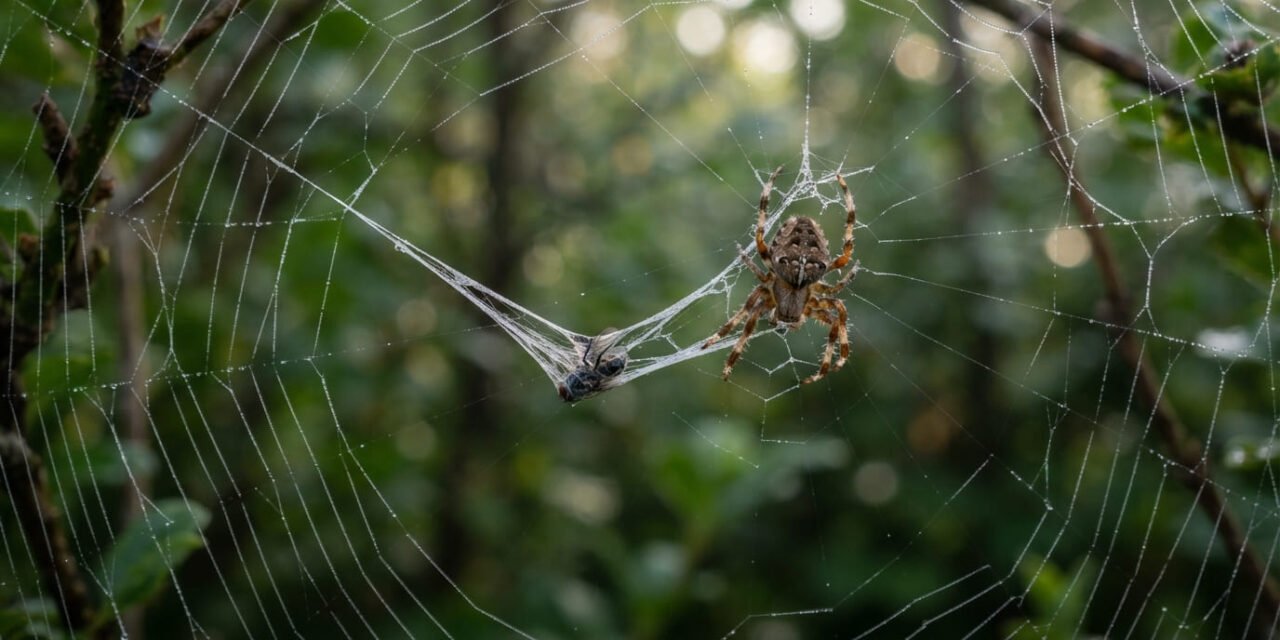
If you walk through a garden in the morning, you will likely see an orb web covered in dew. It looks fragile. You can break it with a flick of your finger. However, on a pound-for-pound basis, the silk that makes up that web is five times stronger than steel. It is twice as elastic as nylon. If we could manufacture a spider web the size of a football field, it would be strong enough to stop a jumbo jet in mid-flight.
The spider does not just create a sticky trap. It manufactures a high-performance material that scientists have tried to replicate for decades. It is a masterpiece of protein engineering. Spiders produce several types of silk, but the most impressive is “dragline” silk. This is the structural frame of the web. It must support the spider’s weight and survive the impact of a flying insect hitting it at high speeds.
The Chemistry of Strength
Spider silk is made of proteins called spidroins. These proteins have a unique structure that combines two opposite properties: stiffness and flexibility. Inside the silk fiber, there are crystals called beta-sheets. These crystals are very hard and provide the “strength” of the material. They are held together by hydrogen bonds that resist being pulled apart.
Between these hard crystals are amorphous, “floppy” regions of protein. These sections are not organized. They are tangled and flexible. When a force pulls on the silk, these floppy regions stretch out. This allows the silk to extend up to 40 percent of its original length without breaking.
This combination is why spider silk is superior to steel. Steel is strong, but it is brittle. If you pull it too hard, it snaps. Nylon is stretchy, but it is weak. Spider silk is both. It has high “toughness,” which in physics means it can absorb a massive amount of energy before it fails.
Absorbing Kinetic Energy
When a bee or a beetle flies into a web, it carries a lot of kinetic energy. If the web were stiff like a glass window, the insect would simply bounce off or shatter the frame. If the web were too soft, it would sag, and the insect would fly right through.
Spider silk solves this with a property called “non-linear elasticity.” When an insect hits the web, the silk initially resists the pull. As the force increases, the silk softens and stretches. This stretching turns the kinetic energy of the insect into heat. The silk absorbs the impact like a car’s crumple zone.
The web also uses a process called “sacrificial bonding.” Inside the silk proteins, some weak bonds break on purpose. This breaking process uses up energy and prevents the main “backbone” of the silk from snapping. Because of this, a spider web can survive a direct hit from a large insect even if a few individual strands break. The rest of the structure remains intact and ready for the next hunt.
The Physics of the Orb
The shape of the web is just as important as the material. A typical orb web has radial lines—the “spokes” of the wheel—and spiral lines. The radial lines are made of dry, stiff dragline silk. The spiral lines are made of a different type of silk called “capture silk.”
Capture silk is coated in a glue-like substance. It is also incredibly stretchy. When an insect hits the spiral, that specific strand stretches significantly. This localization of the stress is key. The web is designed so that the force of the impact stays in the area where the insect landed. It does not spread to the rest of the web and pull the whole structure down.
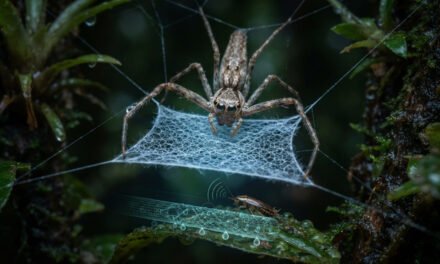
The spider also uses tension to its advantage. The radial lines are pulled tight. This tension allows the spider to feel vibrations from any part of the web. It is a biological telegraph system. The spider sits in the center and monitors the frequency of the vibrations. It can tell the difference between a trapped fly, a dangerous wasp, or a leaf falling into the web just by how the silk shakes.
Manufacturing at Room Temperature
One of the most impressive parts of spider silk engineering is how it is made. To make steel, you need furnaces that reach 2,600 degrees Fahrenheit. To make high-strength plastics, we use harsh chemicals and high pressure.
A spider makes silk inside its body at room temperature using water as a solvent. The silk starts as a highly concentrated liquid protein “dope” stored in a gland. As the spider pulls the liquid through its spinnerets, the acidity changes, and the proteins align. The mechanical pull of the spider’s leg—or the weight of the spider dropping through the air—actually triggers the liquid to turn into a solid fiber.
This is an incredibly efficient manufacturing process. It uses very little energy and produces no toxic waste. The spider can even recycle its material. If a web is damaged or old, the spider will eat the silk to break the proteins back down into amino acids and use them to spin a new web the next day.
Why You Should Care
We are currently using the lessons from spider silk to build better body armor, surgical sutures, and sports equipment. Standard Kevlar vests are heavy and lose their strength if they get wet. A material based on spider silk would be lighter, more breathable, and much tougher.
In medicine, spider silk is valuable because it is biocompatible. The human body does not usually reject it. Doctors have used spider silk to create “scaffolds” for regrowing damaged nerves. The nerves use the silk strands as a bridge to grow across a gap. Because the silk eventually biodegrades, it disappears once the body has healed itself.
The Limits of Synthetic Silk
Despite thirty years of research, we still cannot perfectly mimic what a spider does. We can produce the proteins in labs using genetically modified goats or bacteria, but we struggle with the “spinning” part.
The way the spider pulls and aligns the proteins is a precise mechanical act. If we spin it too fast, the silk is brittle. If we spin it too slowly, it is weak. The spider has a level of control over the fiber’s diameter and strength that our machines cannot yet match. We are getting closer, but for now, the spider remains the superior engineer.
The Architecture of Survival
A web is a temporary structure. Most spiders rebuild theirs every 24 hours. This constant reconstruction allows the spider to adjust the web based on the environment. If it is a windy day, the spider will use thicker radial lines. If prey is scarce, it might build a larger, thinner web to increase its chances.
The web also deals with the “rebound” problem. When an insect hits a web and stretches it, you might expect the web to snap back like a rubber band and catapult the insect away. Spider silk has a property called “damping.” It doesn’t snap back with the same force it was pulled with. It returns to its original shape slowly. This ensures the insect stays stuck in the glue rather than being bounced out of the trap.
Final Thoughts
Spider silk is a reminder that nature often finds the most efficient solution to a problem. The spider needed a way to stop high-speed projectiles using only the proteins it could eat. The result was a material that outperforms our best metals and plastics.
It is a combination of chemical “glue,” crystalline “bricks,” and floppy “springs.” It is a structural network that uses physics to turn a violent collision into a small amount of heat. You can find this engineering marvel in any backyard or basement. It is a high-tech material that has been in production for 300 million years, and we are only now beginning to understand how it works.