Imagine walking through the cool, mist-shrouded cloud forests on the western slopes of the Andes mountains in Colombia or Ecuador. The air is damp, ferns drape from ancient branches, and the forest canopy is alive with the calls of tropical birds. As you stand quietly on a mossy trail, a clear, ringing musical note cuts through the quiet air. It sounds like a violin bow being drawn across a steel string, or a small, crystal bell chiming in the canopy.
You look around for the musician, expecting to see a bird with its beak wide open, pouring its heart out into the damp air. When you finally locate the source of the sound, you find a small, reddish-orange bird with a bright yellow patch on its head perched on a thin branch.
Its beak is completely closed.
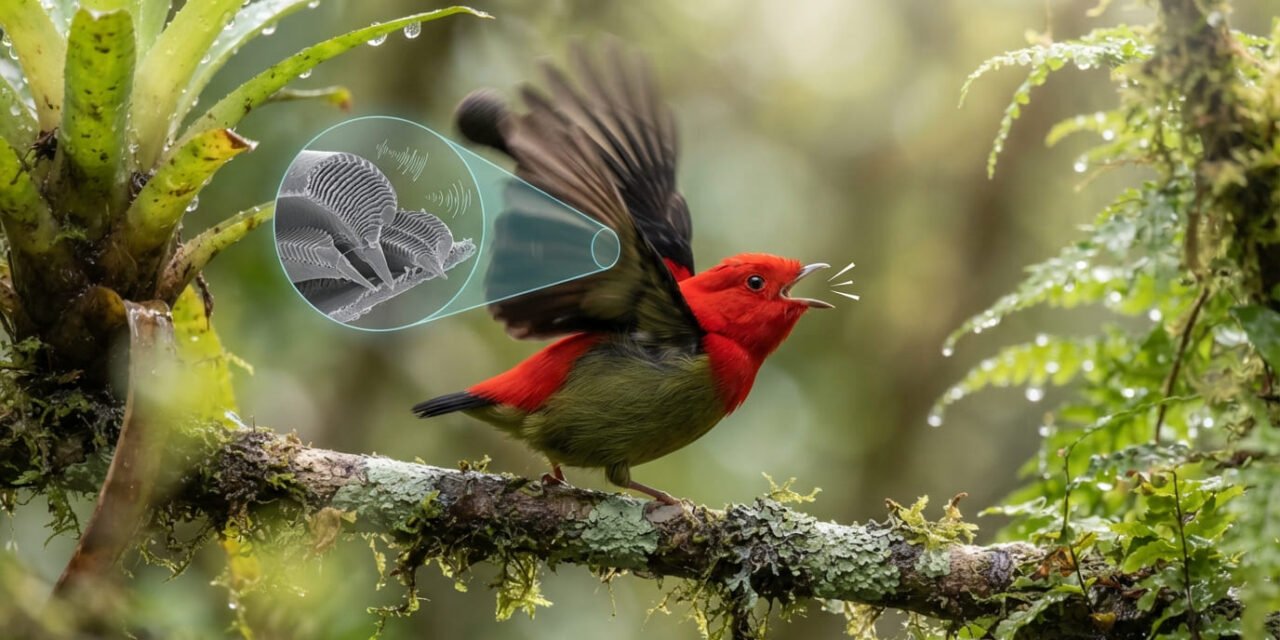
Instead of opening its mouth to sing, the bird lowers its head, arches its tail over its back, and flips its wings upward behind its spine. In a blur of movement far too fast for the human eye to track, the bird’s wings begin to quiver. The clear, violin-like note fills the forest again, produced entirely by the feathers on its wings.
This is the club-winged manakin (Machaeropterus deliciosus). Found only in the high-elevation cloud forests of South America, this small bird holds a unique title in the avian world. It is one of the only birds on Earth that creates sustained, resonant musical notes using the principle of stridulation, rubbing modified body parts together the same way a cricket or a grasshopper chirps in a summer field.
The Problem with Musical Feathers
To understand why the club-winged manakin is so unusual, you first have to look at how birds normally make sound and how feathers usually behave.
The vast majority of songbirds create music using an internal vocal organ called the syrinx, located at the base of their windpipe. By forcing air through fluid-filled membranes, a songbird can produce complex, two-part harmonies without ever needing to move its limbs.
Feathers, on the other hand, are designed for quiet efficiency. They are soft, flexible structures made of keratin, the same protein found in human hair and fingernails. When a bird flies, the feathers are meant to slide smoothly over one another, trapping air for lift while minimizing drag and noise. An owl, for instance, has specialized fringed feathers that deaden the sound of wind so it can drop on prey in total silence.
Making a sharp, clear, and loud musical note requires hard, rigid materials that can snap against each other and resonate. Soft, flexible feathers normally absorb vibrations rather than amplifying them.
For the club-winged manakin to turn its wings into a musical instrument, evolution had to completely overhaul the structure of its wing feathers, turning soft flight tools into rigid, mechanical noise-makers.
The Pick and the File
If you examine the wing of a male club-winged manakin under a microscope, you will see a set of secondary feathers that look nothing like those of any other bird.
Secondary feathers are the flight feathers located along the forearm of the wing. In most birds, these feathers are long, straight, and smooth. In the male club-winged manakin, secondary feathers numbered five, six, and seven have been radically altered.
Feather number six is the “pick.” It features a thick, hardened shaft that bends at a sharp angle near the tip. At the end of this bend is a solid, dark, club-shaped knob.
Feather number five sits directly next to it and acts as the “file.” The central shaft of this fifth feather is heavily thickened and lined with forty-one microscopic, evenly spaced ridges, looking very much like a tiny, corrugated washboard or the teeth of a comb.
When the male manakin wants to perform for a female, he raises his wings behind his back, bringing the inner surfaces of his wings together. He then vibrates his wing muscles at an astonishing speed, moving the wings back and forth more than one hundred times per second.
This rapid vibration causes the curved, club-like tip of feather six to scrape back and forth across the forty-one ridges of feather five. Every single back-and-forth movement produces eighty-two microscopic impacts per cycle.
It is the same physical mechanism used by a violinist. The club-shaped tip acts as the bow, while the ridged shaft acts as the string. As the bow scrapes across the file, it creates a fast series of high-frequency clicks that blend together into a single, continuous, high-pitched musical note centered around 1,500 Hertz.
The Physics of 107 Beats per Second
The sheer speed required to pull off this performance pushes against the absolute limits of muscle physiology.
To produce its characteristic sound, the male club-winged manakin must vibrate its wings at roughly 107 Hertz, or 107 complete cycles every second.
To put that into perspective, a hummingbird, famous for its blindingly fast wingbeats, flaps its wings at about fifty to eighty times per second during normal flight. The club-winged manakin moves its wings significantly faster than a hovering hummingbird, not to fly, but simply to make music while standing completely still on a branch.
When the bird initiates the wing-shaking movement, the vibration travels through the feathers so fast that the wing appears to vanish into a hazy blur. The sound produced is not a simple clicking or buzzing noise, like the sound a turkey makes when it rattles its tail. It is a pure, sustained tone that carries through the dense rainforest air for dozens of yards.
Naturalists who first heard the sound in the nineteenth century assumed it was a vocal call, refusing to believe that a bird could produce a clean, bell-like tone without using its throat. It was only when high-speed cameras and microscopic feather analysis were brought into the field that the true mechanical nature of the song was finally revealed.
The Solid Bone Secret
Scraping two hard feathers together at high speed explains how the clicks are created, but it leaves an even bigger physical puzzle: how does the bird amplify the sound?
If you take two plastic combs and scrape them together in the air, you get a faint, scratchy noise. You do not get a loud, ringing tone that echoes across a forest valley. For the sound to carry, it needs a body to resonate through, much like the hollow wooden body of an acoustic guitar amplifies the vibration of its strings.
For a long time, scientists could not figure out what the manakin was using as its sounding board. The answer was finally discovered when researchers used X-ray scans to look beneath the skin at the bird’s skeleton.
Most birds are famous for having hollow, lightweight bones filled with air pockets. These pneumatized skeletons are vital for reducing weight, allowing birds to take off easily and save energy during long flights.
When scientists scanned the wing bones of the male club-winged manakin, they found something that seemed completely backwards. The ulna, the large forearm bone that supports the secondary flight feathers, was not hollow at all.
It was solid, dense, and heavily swollen, measuring three to four times thicker than the ulna of any other bird of similar size.
The bird turned its own arm bones into a solid, heavy amplifier. Because the ulna is dense and massive, it does not crush or damp under the intense strain of the wing’s vibrations. Instead, the solid bone acts as a rigid sounding board. When the feathers scrape together, the energy transfers directly into the dense forearm bone, which vibrates in harmony with the feathers, amplifying the sound and throwing the musical note out into the surrounding forest.
The Heavy Price of Beauty
While solid forearm bones and heavy, bent feathers make for an incredible violin, they are a complete nightmare for flying.
In the natural world, every evolutionary trade-off comes with a cost. By replacing its lightweight, hollow wing bones with thick, solid struts, the male club-winged manakin sacrificed its flight performance.
The bird is a noticeably awkward flyer. It cannot make long, graceful flights across open canopy gaps, and it lacks the agility and speed of other forest birds. It spends most of its life taking short, heavy hops from branch to branch, burning significantly more energy every time it needs to travel through the woods.
Furthermore, because the secondary feathers are bent, thick, and stiffened for sound production, they generate less lift during flight. The bird effectively crippled its own wings to turn them into musical instruments.
This trade-off is driven by the relentless pressure of sexual selection. In the deep cloud forest, female club-winged manakins are exceptionally choosy. When looking for a mate, a female will visit several male display courts, called leks, where males spend hours shaking their wings and singing.
The female listens carefully to the quality, frequency, and clarity of the wing-song. A male that can produce a loud, perfectly sustained note proves that he possesses massive physical strength, excellent health, and superior genetic quality, because only a prime male can afford the heavy energy cost of carrying solid wing bones and performing those high-speed wingbeats.
If a male cannot produce a clean note, the female simply flies away to find a better musician. Over millions of years, the female’s preference for precise music proved stronger than the survival advantage of easy flight, driving the males to evolve wings that are better suited for a concert hall than the open sky.
A Shared Genetic Burden
One of the most fascinating discoveries about the club-winged manakin involves the female birds. Female manakins do not sing with their wings. They have normal, brown plumage that helps them hide on the nest, and they do not participate in the loud wing-shaking courtship displays.
However, when scientists X-rayed female club-winged manakins, they found that the females also possess slightly thickened, denser ulna bones compared to other bird species.
Because the genetic code for building bones is shared between both sexes, the females carry a portion of the heavy physical burden created by the males’ musical arms. Even though the female never uses her wings to play music, she inherits some of the solid, heavy bone structure that makes flying more difficult.
It is a rare example in nature where a specialized trait driven by sexual selection in males creates a physical compromise for the entire species, proving just how deeply the quest for music has reshaped the biology of this cloud forest resident.
Lessons in Natural Engineering
You should care about the club-winged manakin because it completely rewrites what we thought was possible in animal mechanics. It proves that when evolutionary pressure is strong enough, nature can take a structure built for one purpose—like flying—and completely repurpose it for something else entirely, like acoustic performance.
Acoustic engineers, materials scientists, and instrument designers study the club-winged manakin to learn more about micro-friction and structural resonance. The way the bird uses microscopic ridges to control sound frequency and solid bones to amplify vibrations provides valuable clues for designing lightweight, low-energy acoustic devices, micro-turbines, and synthetic materials that can manage mechanical friction without wearing out.
Human musicians spent thousands of years developing stringed instruments made of horsehair, catgut, and cured wood to create the perfect violin sound. The club-winged manakin achieved the same result using nothing but its own feathers, its arm bones, and the laws of physical friction.
Final Thoughts
The club-winged manakin is a wonderful reminder that the natural world is full of quiet surprises. It is a tiny, bright bird that defies the standard rules of avian flight so that it can fill the damp Andean air with a song made of friction and light.
The next time you hear a violin playing or listen to the wind rustling through the trees, think of this small, reddish bird standing on a mossy branch in Ecuador. Think of a creature that chose to carry heavy, solid bones in its arms so it could turn its wings into an instrument, proving that sometimes, the drive to make beautiful music is worth giving up the ease of flight.