If you spend any time looking closely at the plants in a backyard garden, you will eventually find a colony of aphids. These tiny, soft-bodied insects cluster together on green stems, slowly sucking sap from the plant. Because they are slow and have no armor, they look like an easy, defenseless buffet for any passing predator. But if you try to get too close, you will quickly notice a team of angry ants patrolling the stems.
These ants are not there to eat the aphids. They are acting as highly aggressive guard dogs.
But if you watch the colony for a few minutes, you might spot a very strange sight. A tiny, animated clump of green lichen and dry dirt, about the size of a shirt button, goes for a slow, herky-jerky stroll right up the stem. It looks like a stray piece of garden debris caught in the breeze, but it is moving against the wind.
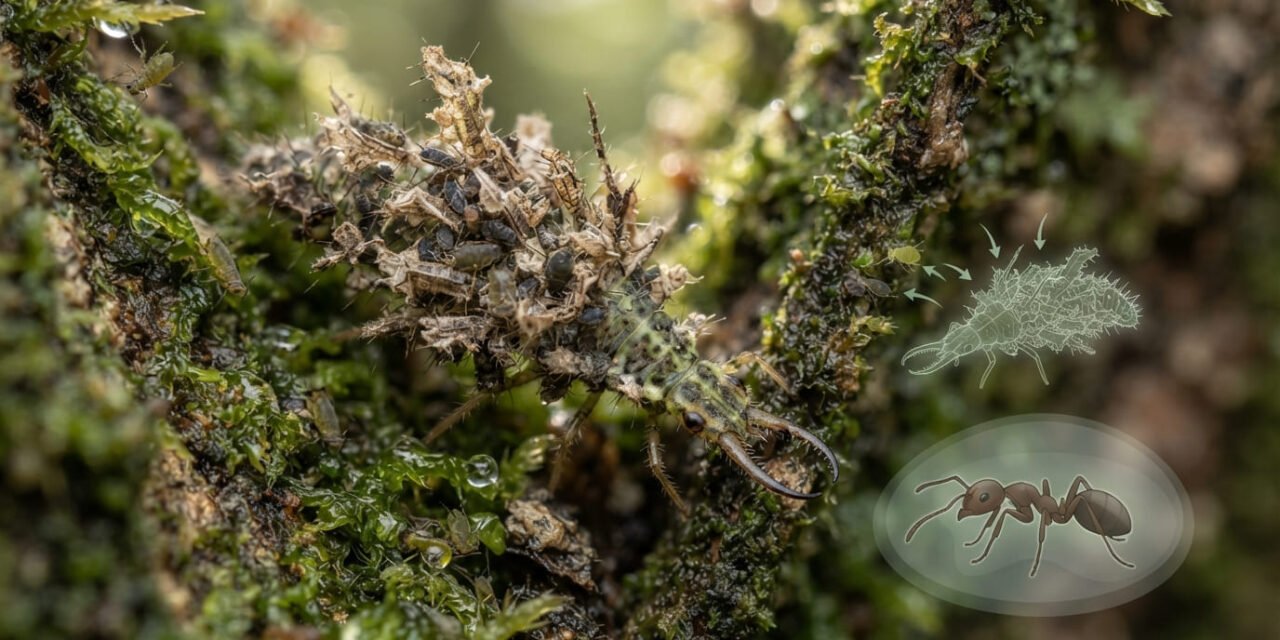
If you flip this little ball of trash over, you will find six tiny legs, a flat head, and a pair of massive, curved jaws. This is the larva of the green lacewing, often called the junk bug or the trash bug.
To survive in a world of protective ants, this tiny predator has developed one of the most clever, macabre camouflage systems in the backyard. It does not just hide under a leaf. It takes the shriveled, empty skins of the aphids it has just eaten, bundles them onto its back, and wears them like a coat. By wearing the literal skins of its victims, the lacewing larva can sneak right past the ant bodyguards to enjoy a massive feast.
The Shepherd and the Sheep
To understand why the lacewing larva needs such a bizarre disguise, you first have to look at the relationship between ants and aphids. In the insect world, this is one of the most famous partnerships.
Aphids feed on plant sap, which is rich in sugars. Because their bodies cannot process all of this sugar, they excrete a sweet, sticky liquid called honeydew. Ants absolutely love this sugary syrup. It is a high-energy food source that can support an entire ant colony.
To keep the sweet honeydew flowing, ants have turned aphids into the insect equivalent of dairy cows. The ants will gently stroke the aphids with their antennae to encourage them to release a fresh drop of honeydew. In return for this constant food supply, the ants protect their herds with fierce loyalty.
If a ladybug, a predatory wasp, or a normal lacewing larva tries to attack the aphids, the guarding ants will attack instantly. They will bite the predator, spray it with formic acid, and physically throw it off the plant. For a small predator, trying to enter an ant-guarded aphid colony is a quick way to get killed.
The aphids get a free team of elite bodyguards, the ants get a reliable sugar factory, and any hungry predator is kept far away. It is a highly successful system that leaves the aphids safe to multiply by the thousands.
The Junk Collector’s Backpack
The lacewing larva is not built for a direct, physical fight with a dozen angry ants. It has a soft, plump body that is easily pierced by ant jaws. But it has a massive appetite. It is so voracious that gardeners call these larvae “aphid lions.”
To get to its food without triggering an ant war, the lacewing larva relies on stealth. It turns itself into a walking pile of compost.
Some species of lacewing larvae have backs covered in specialized, hook-like hairs. These hairs act like natural Velcro. When the larva finds a piece of dry leaf, a bit of bark, or a clump of moss, it grabs the material with its jaws, flips its head backward over its body, and packs the debris onto its back.
As it crawls through the garden, it continuously adds more material, building a dense, protective shield of trash. This shield makes the larva completely invisible to visual predators like birds and lizards, which see nothing but a harmless piece of dirt moving across a leaf.
But when it wants to hunt ant-guarded aphids, the larva gets highly specific with its building materials. It stops collecting leaves and starts collecting carcasses.
Wearing the Enemy’s Uniform
When a lacewing larva attacks an aphid colony, it does not just discard the remains of its meal. Once it has sucked an aphid completely dry, it takes the empty, shriveled skin and tosses it onto its back.
Over a few hours of hunting, the larva accumulates dozens of these dry aphid husks, packing them tightly among the hooked hairs on its spine. Eventually, the larva’s actual body is completely hidden beneath a dome of dead aphids.
This is the ultimate wolf-in-sheep’s-clothing disguise. It works because ants do not have great eyesight. They live in a world of smells and touch. To recognize a friend or an enemy, an ant relies on its sensitive antennae to read the specific chemical scent on an object’s surface.
Because the lacewing larva’s backpack is made entirely of dead aphids, it smells exactly like the aphid herd. When an ant patrol approaches the disguised lacewing, it touches the trash packet with its antennae. The ant’s brain registers the familiar scent of its herd. It assumes it is just touching a clump of aphids or a harmless piece of colony debris.
The ant will literally walk right over the back of the disguised lacewing larva, completely unaware that a ferocious predator is sitting right beneath its feet. The lacewing can sit in the absolute center of the herd, picking off aphids one by one, right under the noses of the bodyguards.
The Biologist’s Experiment
For a long time, people wondered if this disguise was really necessary, or if the ants were just lazy. In the 1970s, a famous biologist named Thomas Eisner decided to test the theory with a simple experiment.
Eisner found a group of debris-covered lacewing larvae feeding in an aphid colony. Using a pair of tiny tweezers and a very steady hand, he carefully peeled the trash packets off the backs of the larvae, leaving them completely naked. He then placed the bare larvae back onto the plant stems.
The results were immediate. The moment the naked lacewings tried to approach the aphids, the guarding ants detected them. Without the chemical disguise of the aphid skins, the ants recognized the larvae as dangerous predators. They attacked the naked lacewings, bit them repeatedly, and threw them off the stems.
But when Eisner took those same larvae, let them rebuild their trash packets, and placed them back on the plant, the ants ignored them completely once again. The experiment proved that the trash packet is a vital passport, allowing the predator to bypass a security system that would otherwise be lethal.
The Juice Box Strategy
The way the lacewing larva eats its prey is also perfectly designed to help build this disguise. The larva is equipped with a pair of long, sickle-shaped jaws that protrude from the front of its head. These jaws are hollow, acting exactly like tiny drinking straws.
When the lacewing spots an aphid, it lunges forward and clamps its curved jaws around the victim’s body. It does not chew. Instead, it injects a highly potent saliva directly into the aphid.
This saliva contains powerful enzymes that digest the aphid’s internal muscles, organs, and tissues within seconds, turning them into a liquid slurry. Once the insides are fully liquefied, the lacewing uses its hollow jaws to suck up the nutrient-rich soup. It is the insect version of drinking a juice box.
When the meal is finished, the aphid’s outer skin remains completely intact, but deflated. It is light, dry, and clean. The lacewing simply lifts this empty husk with its jaws, swings its head back, and adds the new tile to its growing armor of dead bodies.
An Ancient Trick
This bizarre camouflage system is not a new evolutionary experiment. In fact, it is one of the oldest recorded behaviors in the insect world.
Scientists studying prehistoric forests have found fossilized lacewing larvae preserved in pieces of ancient amber dating back over one hundred million years. Remarkably, these fossilized larvae have the exact same specialized, hooked hairs on their backs, and some are still carrying tiny packages of plant fibers and insect debris from the Cretaceous period.
The strategy has survived multiple mass extinctions and the rise and fall of countless other species because it simply works. By combining a physical shield with a chemical disguise, this tiny insect turned a dangerous, heavily guarded pasture into its own personal, worry-free buffet.
The next time you see a tiny piece of lichen taking a quiet walk down a tree branch, take a moment to appreciate the show. You are not looking at a random glitch in the garden. You are looking at a master of stealth that has spent millions of years wearing its dinners to outsmart the security guards of the wild.